
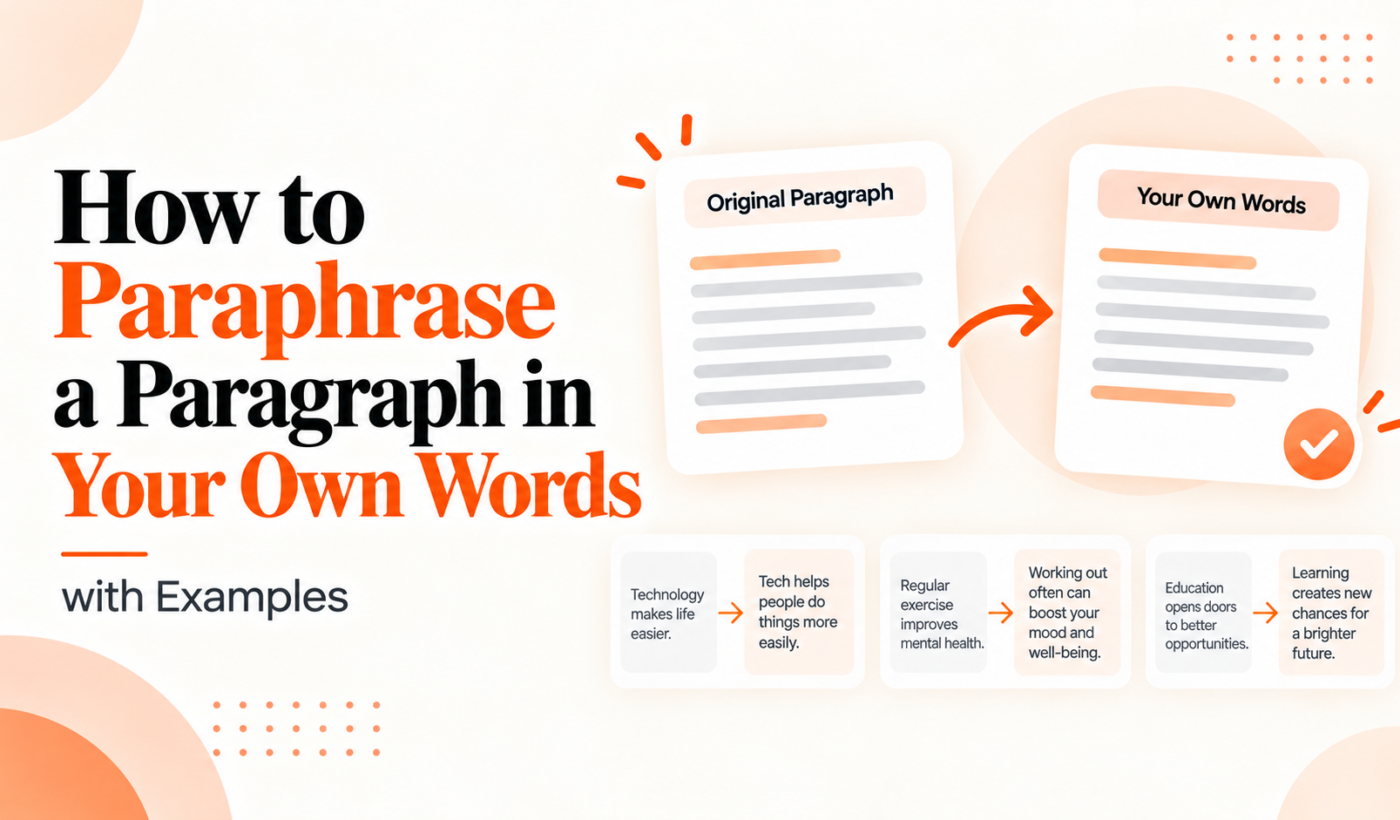
Paraphrase a paragraph means restating someone else’s ideas in your own words while keeping the original meaning. Students and freelancers paraphrase to fit tone, avoid heavy quoting, and make source material clearer for their audience. This article gives a simple 5-step method, concrete paragraph paraphrase examples, a quick checklist, and recommended tools so you can rewrite with confidence.
Why paraphrase a paragraph? When to paraphrase vs. quote or summarize
Why paraphrasing helps students and freelancers
Paraphrasing helps you adapt a source to your voice and audience. Students use it to show understanding in assignments. Freelancers use it to restate client requirements in proposals or to remix research into content that matches their brand voice. Paraphrasing keeps writing concise and avoids long blocks of quoted text.
Paraphrase vs. quote vs. summarize — quick guide
Use a direct quote when the exact wording matters. Summarize when you need to compress long passages into a short overview. Paraphrase a paragraph when you want to keep the same level of detail but express it differently or fit it stylistically into your work.
Avoiding plagiarism: attribution and when to cite
Even when you paraphrase, you usually need to cite the original source if the idea is not common knowledge. Paraphrasing without attribution can still be plagiarism. As a practical rule: if the source informed your point, add a citation or attribution according to your field or the platform rules.
A simple 5-step method to paraphrase a paragraph in your own words
Step 1: Read the paragraph until you understand the meaning
Read the full paragraph twice. Make sure you can explain the idea aloud in one sentence. If you don’t understand the core claim or the evidence, pause and reread surrounding text.
Step 2: Highlight key ideas and terms (notes, not copying)
Mark the main points and any specific terminology. Write short notes—phrases or bullet points—rather than copying full sentences. This keeps you working from ideas, not the original wording.
Step 3: Put the original away and write the idea in your own voice
Close the source and draft your paragraph from the notes. Use your normal tone and sentence structure. Aim to keep the same meaning and level of detail while using different words and phrasing.
Step 4: Compare with the original to ensure accuracy and different wording
Open the original and check for two things: you haven’t changed the meaning, and your phrasing is sufficiently different. If your sentences are still very close, rewrite again focusing on structure and voice changes.
Step 5: Add attribution or citation where required
If the idea requires attribution, add a citation, footnote, or inline credit depending on the format you’re using. For proposals or client work, rewrite client language into your pitch but keep any required acknowledgments.
Paragraph paraphrase examples: bad, better, and best
Below are three practical examples. Each shows a source paragraph followed by a bad paraphrase (too close or inaccurate), a better paraphrase, and a best paraphrase that preserves meaning and voice.
Academic example
Original: Climate change is increasing the frequency and intensity of extreme weather events worldwide, which threatens infrastructure, public health, and food systems. Communities with fewer resources are the most vulnerable to these impacts.
Bad paraphrase: Climate change causes more extreme weather events around the world, threatening infrastructure, public health, and food systems. Poorer communities are most at risk.
Why it’s bad: This is too close to the original wording and sentence order.
Better paraphrase: Rising global temperatures are linked to more frequent and severe storms and heatwaves, putting roads, hospitals, and agriculture at risk. The effects hit low-income communities hardest.
Best paraphrase: As the climate warms, dangerous weather events are becoming more common and severe, endangering infrastructure, health services, and food production—with the greatest harm falling on the least-resourced communities.
Freelance proposal example (turning client language into your pitch)
Original (client brief): We need a website redesign that improves mobile conversions, simplifies navigation, and matches our updated brand style guide.
Bad paraphrase: You need a website redesign to improve mobile conversions, simplify navigation, and match the brand style guide.
Why it’s bad: This repeats the client’s words without adding value or tailoring to a proposal.
Better paraphrase: I will redesign your site to increase conversions on mobile, make the menu and page structure easier to use, and implement your new brand guidelines.
Best paraphrase: I’ll create a mobile-first redesign focused on lifting conversion rates by streamlining navigation and applying your updated brand standards across layouts and microcopy. (Then add a short plan or KPI.)
Freelancers can use a tool like the Upwork Proposal Generator to turn client briefs into tailored proposal language quickly.
Blog/content example (rewriting for tone and clarity)
Original: Small businesses often miss simple marketing wins because they assume digital advertising is too expensive or complicated for their budgets.
Bad paraphrase: Small businesses miss marketing wins because they think digital advertising is expensive or complicated.
Better paraphrase: Many small businesses skip straightforward marketing steps, assuming online advertising is beyond their budget or skills.
Best paraphrase: Small companies frequently overlook easy marketing opportunities, mistakenly believing that online ads are either too costly or too complex to manage.
Short checklist to evaluate your paraphrase
- Does it keep the original meaning and details?
- Are sentence structure and vocabulary different from the source?
- Did you avoid keeping unique phrases or distinctive sentence order?
- Is the voice appropriate for your audience?
- Have you added attribution when required?
Common mistakes when you paraphrase — and how to fix them
Mistake: swapping only a few words (too close)
Problem: You change a couple of words but keep original sentence order. Fix: Rewrite the sentence structure—use different clauses, combine or split sentences, and use synonyms where natural.
Mistake: losing nuance or changing the meaning
Problem: Important qualifiers or exceptions get dropped. Fix: Compare your draft to the source for accuracy. If you lose nuance, add a clarifying phrase or keep a brief quote for precision.
Mistake: awkward sentence structure after rewording
Problem: The paraphrase reads stiff or unnatural. Fix: Read the paragraph aloud, shorten long sentences, and swap passive voice for active where appropriate.
Quick edits: smoothing flow and checking accuracy
- Read aloud to check natural flow.
- Run a grammar check to catch agreement or punctuation issues.
- Ensure technical terms are used correctly; when unsure, keep the original term and cite the source.
Tools, templates, and when to use them
When to use the Paraphrasing Tool for quick rewrites
Use Typing Engine’s Paraphrasing Tool to generate draft rewrites when you need multiple alternatives fast. Treat outputs as starting points—edit for accuracy and tone.
Use the Paragraph Rewriter to adjust tone and flow
After a quick rewrite, refine sentence-level clarity and voice with the Paragraph Rewriter for adjusting tone and flow. It’s useful when you need a paragraph to sound more professional or friendly.
Humanize AI text when a rewrite sounds robotic
If a paraphrase feels mechanical, run it through AI Text Humanizer to make rewrites sound natural. This tool helps restore conversational rhythm and readability.
Run the Grammar Checker and Summarizer as final steps
Before submitting or publishing, use the Grammar Checker for accuracy and fluency to catch issues. Use the Summarizer Tool to create quick source notes when you need to reduce long sources into key points first.
Practice prompts, templates, and a submission checklist
Three 10-minute practice prompts
- Pick a short news paragraph and paraphrase it twice: once for an academic tone, once for a social post.
- Take a client job description and practice rewriting it into a 2-sentence proposal opener. Try the Upwork Proposal Generator for ideas.
- Summarize a long paragraph into three bullet points with the Summarizer Tool to create quick source notes, then expand each bullet into a new paragraph in your voice.
Quick paraphrase template (5 lines to follow)
- Line 1: One-sentence restatement of the main idea in plain language.
- Line 2: One sentence with supporting detail, using different structure.
- Line 3: Replace any unique terms with synonyms or keep them and cite.
- Line 4: Add a brief linking sentence to fit your article or proposal context.
- Line 5: Add citation or attribution if the idea is not common knowledge.
Final checklist before you submit or publish
- Meaning preserved and important details kept?
- Wording differs sufficiently from the source?
- Tone matches your audience?
- Grammar and punctuation checked with the Grammar Checker for accuracy and fluency?
- Optional: Humanize the text if it sounds robotic using Humanize AI text for free (AI Text Humanizer — final polish).
Additional reading and related examples on Typing Engine
For more before-and-after examples see Paragraph Rewriter examples for emails, blogs, and proposals. If you’re focused on accuracy while rewriting, read How to Rewrite a Paragraph Without Changing the Meaning. For more curated paraphrasing examples and a checklist, check Paraphrasing Examples: Bad, Better, and Best Rewrites (with Checklist).
FAQ
What’s the difference between paraphrasing and summarizing?
Paraphrasing restates the same level of detail in new words. Summarizing condenses longer content into a shorter overview with fewer details.
How can I paraphrase a paragraph without accidentally plagiarizing?
Understand the idea, write from notes with the original closed, change structure and wording, and add a citation when the idea isn’t common knowledge.
Is it okay to use AI or paraphrasing tools to rewrite a paragraph?
Yes, tools can speed up drafts. Always edit outputs for accuracy and voice, and ensure you add attribution when needed. Treat tools as an assistant, not a final authority.
How long should a paraphrase be compared with the original paragraph?
A paraphrase is usually similar in length to the original because it preserves the same level of detail. If you shorten it significantly, you may be summarizing instead.
Do I still need to cite the original source after paraphrasing?
Yes—if the idea, data, or analysis belongs to someone else and is not common knowledge, include a citation or attribution even when paraphrased.
Try Typing Engine’s free Upwork Proposal Generator to quickly turn client briefs into polished proposal language and practice paraphrasing client requests: Generate a free personalized Upwork proposal.