
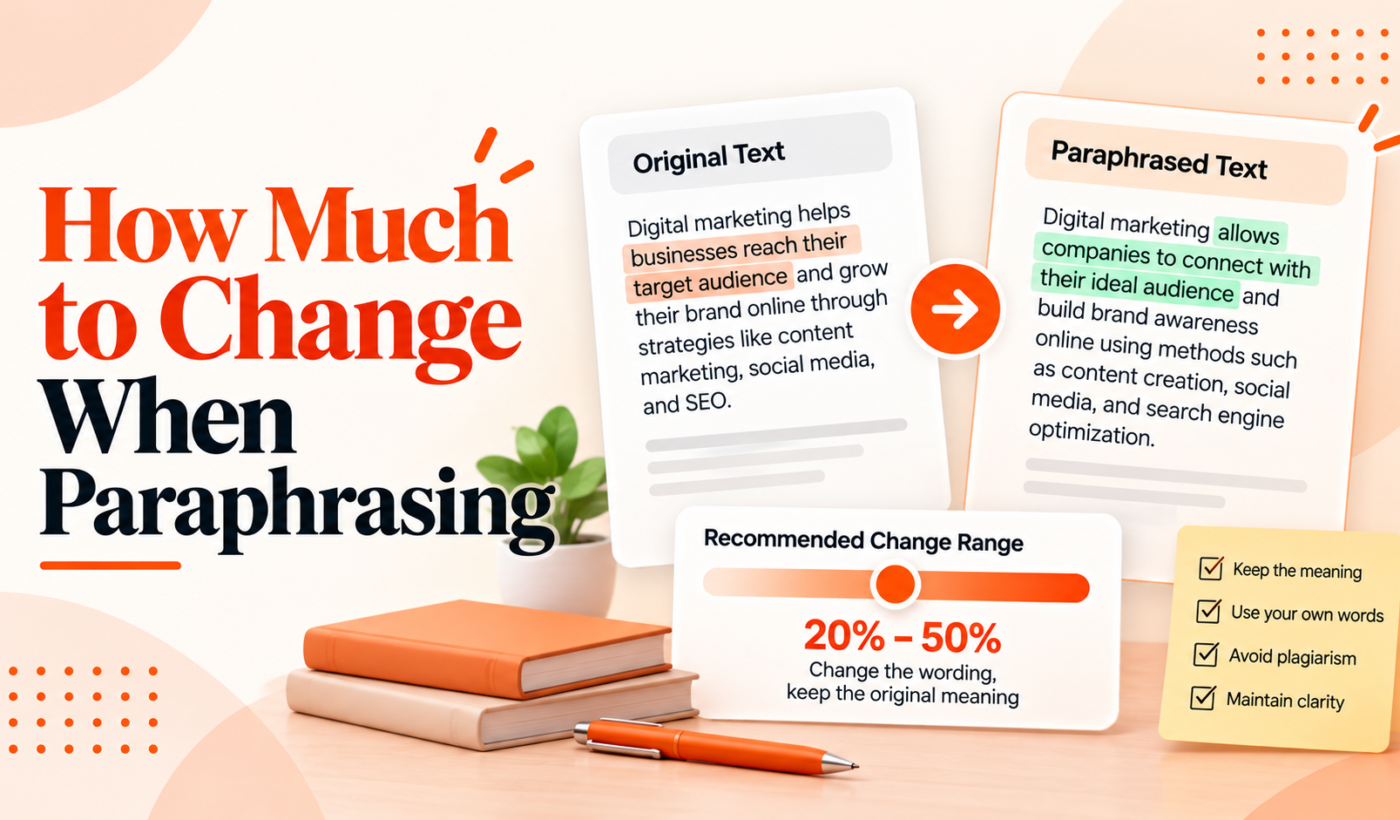
Paraphrasing sounds simple, but students and researchers often ask: how much to change when paraphrasing so your work is accurate, original, and properly cited? This guide gives practical rules, clear before-and-after examples, and a quick checklist you can use before you submit.
What paraphrasing is and why it matters
Definition: paraphrase vs summary vs quote
A paraphrase restates someone else’s idea in your own words at roughly the same length and level of detail. A summary condenses the main points into a shorter form. A quote uses the original wording and is enclosed in quotation marks with a citation. Choosing between them depends on whether you need the original phrasing (quote), a short overview (summary), or a full restatement in your voice (paraphrase).
If you’re unsure whether to summarize or paraphrase, try the Summarize text for free tool to compare a condensed version against the source before you rewrite it.
Why proper paraphrasing matters for students and researchers
Good paraphrase shows you understand the source and lets you integrate others’ ideas into your argument. Poor paraphrase risks plagiarism, misrepresenting the source, or losing important nuance—any of which can hurt your grade or credibility.
Common consequences of weak paraphrasing (plagiarism, misrepresentation)
Weak paraphrase often keeps the source’s structure and key phrases too close to the original, or swaps only a few words. That can lead to charges of plagiarism or produce an inaccurate summary of the source’s argument.
How much should you change when paraphrasing: Practical rules
Rule 1: Change wording and structure, keep the original idea intact
Don’t just swap words. Recast sentences, change the sentence order if needed, and express the idea using your own sentence patterns while preserving the original meaning. Your paraphrase should be clearly different in wording and structure, but faithful to the idea.
Rule 2: Don’t rely only on synonyms — rework sentence structure and flow
Replacing words with synonyms is a start, but it often leaves the same grammar and rhythm as the source. To avoid this, change the voice (active ↔ passive), split long sentences into two, or combine short sentences. That changes the paraphrase structure and removes too-close similarity.
Rule 3: Retain technical terms and proper nouns but explain them in your own words
Specialized vocabulary, names, and established terms should remain. Instead of altering technical terms, explain them differently or place them in a new sentence that clarifies the concept for your reader.
Why percentage-based rules (e.g., “change 70%”) are misleading
Guidelines like “change X%” are vague and machine-focused. Plagiarism is not decided by a percentage of changed words but by whether your text is an independent restatement and properly attributed. Focus on accuracy and new wording, not an arbitrary percent.
Paraphrase structure: techniques and step-by-step examples
Techniques: change voice, split or combine sentences, change order, translate then rephrase
Useful techniques include:
- Switching voice (active ⇄ passive).
- Splitting long sentences into two or more sentences.
- Combining short related sentences into one concise sentence.
- Changing the order of ideas (start with the result instead of the cause).
- Translate-then-rephrase: mentally translate the idea into simpler words, then rephrase in your own academic tone.
Example 1: Simple sentence paraphrase
Original: “Sleep deprivation reduces attention span and impairs memory consolidation.”
Poor paraphrase: “Lack of sleep lowers attention and hurts memory consolidation.”
Good paraphrase: “When people don’t get enough sleep, they tend to have shorter attention spans and their ability to form long-term memories is impaired.”
Notes: The good paraphrase changes sentence structure and order while keeping technical terms like “memory consolidation.”
Example 2: Complex sentence paraphrase (split and reframe)
Original: “Although the intervention reduced symptoms in the short term, long-term follow-up showed no significant difference between the treatment and control groups.”
Poor paraphrase: “The treatment lowered symptoms briefly, but later follow-up found no notable difference between treatment and control.”
Good paraphrase: “The treatment produced symptom relief initially, but follow-up over a longer period found that outcomes were similar for both the treatment and control groups.”
Notes: The good paraphrase reorders information and replaces phrasing with a different sentence rhythm.
Example 3: Preserving technical meaning while rewording
Original: “The polymerase chain reaction amplifies DNA segments exponentially, enabling detection of low-abundance sequences.”
Poor paraphrase: “PCR amplifies DNA rapidly, making it possible to detect rare sequences.”
Good paraphrase: “Polymerase chain reaction (PCR) uses repeated cycles to exponentially amplify specific DNA fragments, which allows researchers to identify sequences present at very low amounts.”
Notes: Keep the technical term “polymerase chain reaction” and explain the mechanism in fresh words to keep accuracy.
Paraphrase citation: when and how to cite
When a paraphrase needs a citation
If the idea, data, or interpretation comes from someone else, cite it—even when you paraphrase. Citations show the source of the idea and let readers check the original.
Short examples: APA-style in-text paraphrase, MLA attribution, and note on Chicago
APA (in-text): Paraphrase with author and year: (Smith, 2020). Example: According to Smith (2020), sleep loss reduces attention over time.
MLA: Use a signal phrase and parenthetical page if available: According to Smith, sleep loss reduces attention (45).
Chicago (notes or author-date): Use a footnote or parenthetical citation depending on your chosen Chicago style variant.
Attribution language to use (e.g., “According to X,”)
Simple attribution phrases work well: “According to X,” “X found that,” or “In X’s study,” followed by the paraphrased idea and a citation. That makes responsibility and source clear.
Avoiding common citation mistakes
- Don’t paraphrase an idea and omit the citation because it’s not a direct quote.
- Don’t cite only at the end of a paragraph that includes multiple paraphrased ideas from different sources—place citations close to each idea.
Checklist: acceptable paraphrase before submission
Use this quick 10-item checklist before you submit:
- Does the paraphrase use my own sentence patterns rather than the source’s wording?
- Have I avoided just swapping synonyms?
- Are technical terms and names left intact and clearly explained?
- Does the paraphrase preserve the original meaning and nuance?
- Is there a citation immediately after the paraphrased idea where required?
- Have I added linking text that clarifies how the source fits my argument?
- Have I run a grammar and clarity check to detect accidental wording that matches the source?
- Did I run the text through a plagiarism checker if required by my institution?
- Have I reviewed the paraphrase aloud to hear awkward or mechanical phrasing?
- Did a peer, mentor, or advisor review the paraphrase when the assignment demanded it?
Improve paragraph flow with the Rewrite a paragraph for free tool, and run a final pass with Check grammar for free.
Tools and workflows for safer paraphrasing
Suggested workflow: draft → paraphrase → humanize → grammar check → cite → final read
Practical steps:
- Draft your section in your own words where possible.
- Use a paraphrasing tool to generate alternatives.
- Humanize the output to remove mechanical phrasing.
- Run grammar and clarity checks and fix subtle wording issues.
- Add citations and attribution language.
- Read aloud and get a peer review if available.
Which free Typing Engine tools to use at each step
- Draft → use your notes and sources.
- Paraphrase → Paraphrase text for free.
- Humanize → Humanize AI text for free to fix mechanical wording.
- Grammar check → Check grammar for free.
- Summarize vs paraphrase comparison → Summarize text for free.
For help deciding whether to trust automatic edits or do manual work, read AI Text Humanizer vs Manual Editing: When Freelancers Should Use Each.
When to get a peer or mentor to review
Ask for a review when the source material is critical to your argument, technically complex, or when your institution’s policy requires oversight.
Common pitfalls and how to avoid them
Mosaic paraphrase and why it’s risky
Mosaic paraphrase mixes a few source phrases with your own words and is treated as plagiarism. Avoid by fully rephrasing sentence structures and using citations.
Losing nuance or technical accuracy — how to check
Compare your paraphrase against the original: if the meaning shifted or important qualifiers disappeared, revise. For technical content, keep domain terms and check with a subject-matter reviewer.
Over-reliance on paraphrasing tools: always review and attribute
Tools speed up rewording, but they can produce robotic text or subtle inaccuracies. Always humanize, check for accuracy, and add proper citations.
If an automated rewrite feels mechanical, use AI Text Humanizer to restore natural tone.
Quick examples and comparison takeaways
Example summary A: straightforward rewording
Before: “Exposure to green space reduces stress.” After: “Spending time in green environments lowers stress levels.” Takeaway: Same meaning, new wording and structure.
Example summary B: restructuring a paragraph
Before: long sentence listing methods and results. After: split into two sentences—method first, then results. Takeaway: Splitting clarifies causality and reduces similarity.
Three takeaways to remember
- Change wording and structure, not just words.
- Keep technical terms and cite the source.
- Use tools, then humanize and verify accuracy.
FAQ
How much should you change when paraphrasing to avoid plagiarism?
Don’t count words. Make sure your phrasing and sentence structure are your own and that you include a citation for the original idea. Accuracy matters more than an arbitrary percent change.
Do paraphrases always need a citation?
Yes—if the idea, finding, or interpretation came from another source. Citations show where the idea originated even if you use your own words.
Is it okay to keep key technical terms when paraphrasing?
Yes. Keep technical terms and proper nouns. Explain or reframe them in a fresh sentence if the audience needs clarification.
Can I use paraphrasing tools for academic work?
Yes, as long as you treat tool output as a draft. Humanize, verify for accuracy, and always add proper citations. Use tools responsibly and follow your institution’s policies.
What are quick steps to check that my paraphrase is acceptable?
Run the 10-item checklist above, read aloud, run a grammar check, and have a peer or mentor review if possible.
Conclusion and next steps
Recap: focus on changing wording and structure while keeping the original idea and including proper citation. Avoid percent-based rules and use the checklist before you submit.
Try a safe paraphrasing workflow: draft, use Paraphrase text for free, Humanize AI text for free, then Check grammar for free. For freelancers applying these skills to proposals, Try Typing Engine’s free Upwork Proposal Generator to draft client-facing text that stays original and well-cited.