
If you have spent time on Upwork and noticed that different sources call your job application a “cover letter” in some places and a “proposal” in others, you are not alone. The terminology is genuinely confusing — both inside and outside the platform. Upwork itself uses both terms in different contexts, freelancers debate the distinction in community forums, and beginners often waste time worrying about a difference that, in practice, is much simpler than it sounds.
This guide clears up the confusion for good. We will explain what each term actually means on Upwork, where the distinction genuinely matters, and — most importantly — how to write whichever document you are submitting so that clients actually respond.
The Short Answer: Are They the Same Thing?
For the vast majority of Upwork situations, yes — a cover letter and a proposal mean the same thing.
When you apply to a job on Upwork, you fill in a text box that Upwork calls the “cover letter.” This is your written pitch to the client. It is how you introduce yourself, demonstrate that you understand their project, and explain why you are the right person for it. Most freelancers and most clients use “cover letter” and “proposal” interchangeably to refer to this document.
The distinction only becomes meaningful in one specific, more advanced scenario — and we will cover that in a moment. For now, if you are a freelancer applying to jobs on Upwork and you are wondering whether you need to submit something called a “cover letter” and something else called a “proposal,” the answer is: you are already doing both. They are the same submission.
Where the Distinction Actually Exists
Long-tail keyword placement: what is the difference between Upwork cover letter and proposal
Some experienced Upwork freelancers make a meaningful distinction between the two terms based on their strategic approach to winning work:
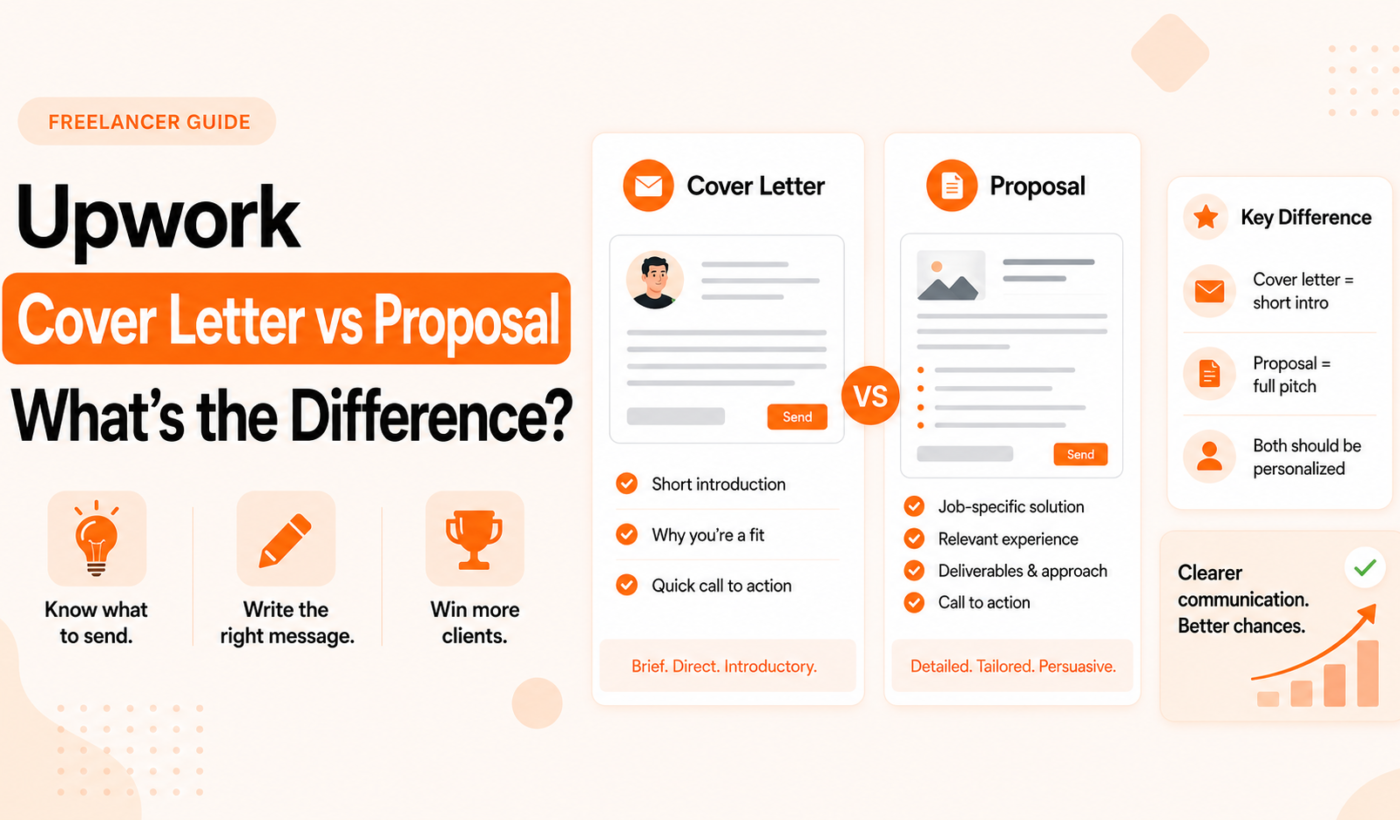
A cover letter in this stricter sense is the initial pitch you submit when applying to a job — a brief, targeted message designed to get the client interested enough to respond. It is short (150–300 words), client-focused, and written to open a conversation rather than close a deal. Its job is to get a reply.
A proposal in this stricter sense is a more detailed document — sometimes a formal PDF or structured written plan — that outlines your specific approach, timeline, deliverables, pricing, and methodology for a project. It comes after the initial conversation, once you and the client have discussed the project and agreed on the general scope. It is a formal business document, not a cold pitch.
In this framework, the sequence looks like this: you submit a cover letter → the client responds → you have a conversation → you send a detailed proposal. This approach works particularly well for complex, high-value projects where the scope needs to be defined before pricing can be finalized.
For smaller, well-defined jobs on Upwork — a logo design, a 1,000-word article, a landing page build — there is typically no need for a separate formal proposal. The initial cover letter covers everything the client needs to make a hiring decision.
The practical takeaway: If a job posting is clear and well-scoped, write a strong cover letter and treat it as your full application. If a job is complex, high-value, or ambiguously scoped, use your initial cover letter to start the conversation, then offer to send a formal proposal with details after you have spoken.
How to Write a Winning Upwork Cover Letter
Focus keyword placement: Upwork cover letter Long-tail keyword placement: how to write a winning Upwork cover letter
Whether you call it a cover letter or a proposal, the principles for writing something that actually generates replies are the same. Here is what separates cover letters that get responses from those that get ignored.
Start With Something That Proves You Read the Job Post
The single most effective technique for standing out in Upwork applications is to reference something specific from the job description in your very first sentence. Not a paraphrase of the title. Not a vague acknowledgment that you saw their post. A specific detail that proves you actually read and understood what they need.
If the client mentions a specific deadline, a particular platform, an industry they work in, or a challenge they are trying to solve — open with that. It immediately differentiates you from the dozens of freelancers who copy-paste the same opener on every application.
Compare these two openers for a web development job:
Generic: “Hi, I’m a web developer with 5 years of experience in React and Node.js. I’d love to help with your project.”
Specific: “Your note about needing the authentication system integrated before your product launch next month caught my attention — I’ve handled three very similar integrations in the past year, and I know exactly where the edge cases tend to appear.”
The specific version proves reading happened. It signals competence. And it makes the client feel like they are talking to someone who actually understands their situation.
Keep It Short: 150–300 Words Is the Sweet Spot
Clients on Upwork are reviewing many applications. A cover letter that runs to five paragraphs is not impressive — it is a burden. The goal of a cover letter is to earn a response, not to explain everything you have ever done.
Aim for 150 to 300 words for most applications. If the job is genuinely complex and requires a longer explanation of your approach, you can stretch to 400 words — but go beyond that only if every sentence is earning its place. When in doubt, cut.
The cover letter is not the place to share your full career history. It is the place to demonstrate that you understand the client’s problem and that you have solved it before.
Structure That Works
The most effective Upwork cover letters follow a three-part structure:
Opening (2–3 sentences): Reference the specific job and show you understood it. This is where your proof-of-reading goes.
Middle (2–4 sentences): Briefly explain your relevant experience. One specific past result is worth more than three generic claims. “I built a similar integration for a healthcare SaaS in Q3 and delivered it three days ahead of schedule” beats “I have extensive experience with healthcare software.”
Close (1–2 sentences): End with a direct question or a clear next step that invites a response. Do not trail off. “Would it make sense to schedule a quick call to walk through your requirements?” is a better close than “Looking forward to hearing from you.”
The Code Word Trick
Many experienced Upwork freelancers have noticed that some clients embed a code word or specific question in their job description — often with a line like “Include the word [X] at the start of your proposal so I know you read this.”
This trick is designed to filter out copy-paste applicants. If you miss it, your application goes to the bottom of the pile regardless of your qualifications. Read every job description carefully before applying, and respond to any embedded instructions directly at the start of your cover letter.
What a Formal Upwork Proposal Looks Like
Long-tail keyword placement: how to write Upwork proposal that gets replies
When a project is complex enough to warrant a separate, detailed proposal document, the structure shifts significantly. A formal proposal goes beyond your cover letter and gives the client a complete picture of how the project will unfold.
Here is what a strong formal proposal typically includes:
Project understanding: A brief summary in your own words of what the client is trying to achieve. This demonstrates that you have processed what they told you, and it gives the client a chance to correct any misunderstandings before work begins.
Your approach: A description of how you would tackle the project — the phases, the methods, the tools, and the decisions you would make along the way. Clients hiring for complex projects want to know that you have a process, not just skills.
Deliverables and timeline: What you will produce and by when. Break larger projects into milestones whenever possible, as this creates clarity on both sides and reduces scope creep.
Pricing: Your rate and how it is structured — hourly, fixed-price per milestone, or total project fee. For complex projects, breaking down pricing by phase or deliverable helps clients understand what they are getting for their money.
About you: A brief section on your relevant experience and credentials — but keep it focused. The proposal is mostly about the project, not about you.
Next steps: What happens after the client reads this. Do they schedule a call? Do they accept the milestone setup? Give them a clear path forward.
This type of proposal is typically delivered as a well-formatted document (PDF or shared document), separate from the initial cover letter text box on Upwork.
Common Mistakes in Both Cover Letters and Proposals
Secondary keyword placement: Upwork proposal tips
Whether you are writing a quick cover letter or a detailed proposal, these mistakes consistently cost freelancers interviews and contracts.
Talking about yourself instead of the client’s problem. “I am passionate about web development” tells the client nothing useful. “I have solved exactly this kind of authentication problem three times in the past year” does.
Being vague about your approach. “I will take care of everything and make sure it’s done right” is not a plan. Clients on high-value projects want to see your process, not just your confidence.
Underselling your relevant experience. Many freelancers have the perfect background for a job but bury it in the fifth paragraph or do not mention it at all. If you have done something directly relevant, say so early.
Sending the same letter to every client. Personalized Upwork proposals have a measurably higher response rate than generic ones — up to 35% higher by some estimates. Clients can tell when they are reading something that was written for them and something that was copy-pasted.
Skipping the close. A letter that ends without a clear call to action forces the client to decide what to do next. Make it easy: tell them.
Starting with price. Unless the client explicitly asks you to include pricing in your initial application, do not lead with it. Price comes after value is established — not before.
Quick Reference: Cover Letter vs. Proposal
| Cover Letter | Formal Proposal | |
|---|---|---|
| When used | Initial job application | After initial conversation for complex projects |
| Length | 150–300 words | 500–2,000+ words |
| Format | Plain text in Upwork editor | Document (PDF or shared link) |
| Goal | Earn a response / start conversation | Close the deal / define the scope |
| Includes | Hook, relevant experience, call to action | Understanding, approach, deliverables, pricing, next steps |
| Tone | Conversational and direct | Professional and structured |
| For beginners? | Yes — every application | Mostly for experienced freelancers on high-value work |
Related Resources from Typing Engine
Free AI Tools for Freelancers
- Upwork Proposal Generator — Write personalized Upwork proposals in seconds
- LinkedIn Post Generator — Build your freelance brand on LinkedIn
- LinkedIn Bio & Headline Generator — Complement your Upwork profile with a strong LinkedIn presence
- Twitter / X Bio Generator — Craft a sharp professional bio for social platforms
- Instagram Caption Generator — Grow your freelance brand on Instagram
- Privacy Policy Generator — Protect your freelance website instantly