
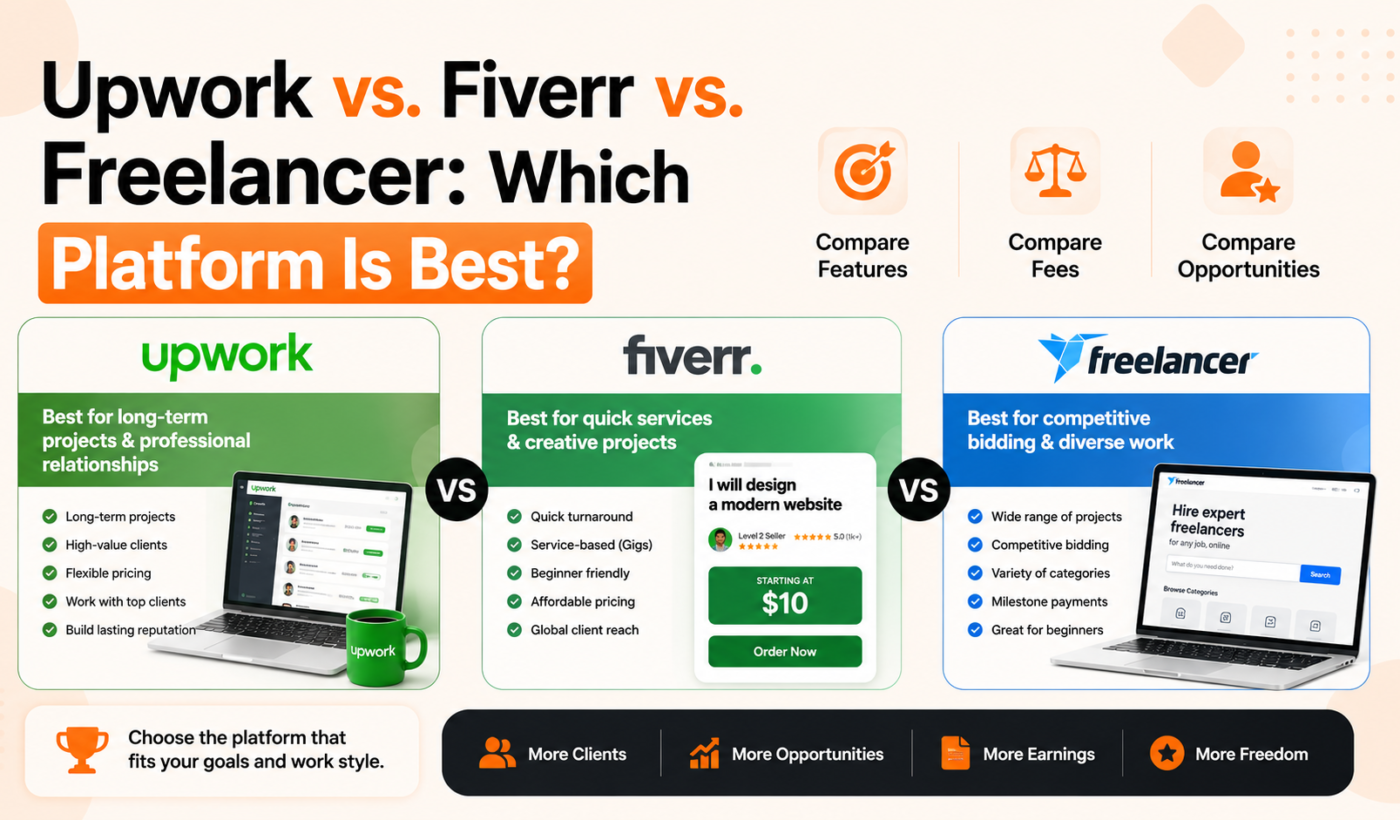
If you have spent any time researching freelance platforms, you have probably noticed that everyone seems to have a strong opinion. Upwork loyalists swear it is the only platform for serious work. Fiverr sellers love how easy it is to get started. Freelancer.com users appreciate the sheer volume of jobs available. And somehow, all three of them are right — for different reasons and different people.
The honest answer to “which freelance platform is best” is that it depends entirely on what you are trying to do. The platform that is perfect for a developer building long-term client relationships is not the same platform that works best for a designer selling logo packages to one-off buyers. And the platform that is ideal for a budget-conscious client is not the same one that suits an enterprise team hiring specialized expertise.
This guide cuts through the noise. We are going to put Upwork vs. Fiverr vs. Freelancer.com head-to-head across every dimension that actually matters — fees, client quality, how you get work, how you grow, and who each platform ultimately serves best. By the end, you will know exactly which one fits your situation.
Platform Overview: Who They Are and What They Stand For
Before comparing the details, it helps to understand the fundamental philosophy behind each platform. They were built for different things.
Upwork
Upwork was formed in 2015 through the merger of Elance and oDesk, two of the earliest freelance platforms on the internet. It is now the largest professional freelance marketplace by revenue, commanding a 61% market share in its category. With 18+ million registered freelancers across 180+ countries and 5+ million active clients, it is the platform most associated with serious, long-term professional work.
Upwork operates on a proposal-based bidding system. Clients post jobs. Freelancers browse those postings and submit customized proposals. The platform skews toward complex, higher-value engagements — software development, marketing strategy, business consulting, long-form content, and ongoing retainer relationships. It is the closest thing to a professional services marketplace that exists in the gig economy.
Fiverr
Fiverr launched in 2010 with a concept that was almost radical at the time: fixed-price service packages, priced from $5, that sellers listed and buyers could purchase immediately like products on an e-commerce store. The $5 price floor is largely historical now — Fiverr’s top sellers earn thousands of dollars per order — but the underlying model remains the same.
Fiverr is a gig-based marketplace. Freelancers (called “sellers”) create pre-packaged offerings called “Gigs.” Clients (called “buyers”) browse those Gigs and purchase what they need, often without any back-and-forth negotiation. The model is fast, accessible, and particularly well-suited to defined, deliverable-driven services: logo design, social media graphics, voiceovers, short-form writing, video editing, and similar work.
Freelancer.com
Freelancer.com is one of the oldest platforms in this space, founded in 2009 through a series of acquisitions. It claims 50+ million registered users across 247 countries, making it the largest freelance platform by registered user count. However, active use and earnings quality tend to be lower than Upwork in most professional categories.
Freelancer.com uses a bidding system similar to Upwork, but it also offers a unique contest model where clients post a brief and multiple freelancers submit work for review, with the winner being paid and the rest earning nothing. This model is common for logo design and similar creative work. The platform tends to attract more budget-conscious clients and has a higher concentration of lower-priced projects than either Upwork or Fiverr.
Fee Structure: What Each Platform Actually Takes From You
LSI keyword: Upwork fees, Fiverr fees, Freelancer.com fees
Fees are often the first question freelancers ask, and the answer is more nuanced than a single percentage. Here is the full picture.
Upwork Fees in 2025
Upwork moved to a variable freelancer service fee of 0% to 15% in 2025, replacing the previous flat 10% structure. The specific rate depends on factors like demand for your skill set, the type of project, and current marketplace conditions. Some freelancers are seeing lower fees on high-demand skills; others are paying at the upper end of the range.
The practical takeaway: budget for up to 15% on new client relationships and expect that rate to potentially improve over time with the same client as your billing history grows.
Client fees: Clients pay a 5% marketplace service fee on most contracts. Business Plus plan clients pay 10%.
Fiverr Fees in 2025
Fiverr charges a flat 20% commission on every sale, regardless of the order size. There are no exceptions, no volume discounts, and no ways around it. If you earn $500 on a Fiverr order, Fiverr takes $100.
Buyer fees: Buyers pay an additional 5.5% service fee on orders, plus a $2 processing fee on orders under $50.
The simplicity of Fiverr’s fee structure is its only advantage in this category. The flat 20% is the highest commission rate of the three platforms and is a meaningful constraint on how you should price your services.
Freelancer.com Fees in 2025
Freelancer.com has the most complex fee structure of the three. For fixed-price projects, freelancers pay 10% or $5, whichever is greater. For hourly projects, the fee is 10% on every payment received. Contest prize winners pay 10% or $5, whichever is higher.
Membership plans add another layer. Free members can only bid on 8 jobs per month, which is severely limiting for anyone serious about landing work. Paid memberships range from $0.99 to $59.95 per month and offer more bids, lower fees, and better visibility.
Client fees: Clients pay 3% or $3 on fixed-price projects and 3% on hourly payments.
Fee Comparison at a Glance
| Platform | Freelancer Fee | Client Fee | Notes |
|---|---|---|---|
| Upwork | 0% to 15% (variable) | 5% to 10% | Variable based on demand and skill type |
| Fiverr | 20% flat | 5.5% + $2 under $50 | No exceptions or volume discounts |
| Freelancer.com | 10% or $5 min | 3% or $3 min | Bidding limits on free plan; paid plans required for serious use |
For most freelancers earning a meaningful income, Upwork’s variable structure is the most favorable over time. Fiverr’s flat 20% is the most expensive at scale. Freelancer.com’s base fee is competitive but the platform limitations on free accounts add hidden costs.
How You Get Work: The Fundamental Model Difference
Focus keyword placement: “Upwork vs Fiverr vs Freelancer” — the model difference is the heart of the comparison
This is the most practically important difference between the three platforms, and understanding it will tell you more about which is right for you than any fee table can.
On Upwork: You Hunt
You actively search for jobs, apply with custom proposals, and compete against other freelancers. The process is more involved but gives you significant control over which clients you work with and the ability to craft a tailored pitch for each opportunity.
The upside: Upwork’s client base tends to have larger budgets, more clearly defined projects, and a stronger appetite for ongoing relationships. Clients who post on Upwork are often businesses with real budgets, not individuals looking for the cheapest option they can find.
The downside: Getting started takes real work. Without reviews, your proposals have a harder time cutting through. The platform requires consistent effort to maintain visibility and momentum.
On Fiverr: Clients Hunt You
You create Gig listings — your fixed-price service packages — and clients browse and buy. You do not write custom proposals. You do not compete in real time for each job. You set up your offerings, optimize your Gig titles and descriptions with relevant keywords, and wait for buyers to find you.
The upside: It is genuinely easier to get your first paying client on Fiverr than on Upwork. The barrier to entry is lower, the workflow is simpler, and if your Gig is well-optimized, you can generate semi-passive inbound orders.
The downside: You have less control over who buys your service, project scopes can be poorly defined, and scaling your rates is harder on a platform where buyers are conditioned to expect fixed, package-style pricing. The flat 20% fee also bites into margins, especially at lower price points.
On Freelancer.com: You Hunt, With More Competition and Lower Budgets
The Freelancer.com model is most similar to Upwork — clients post projects, freelancers bid — but the ecosystem is meaningfully different. The platform tends to attract more budget-conscious clients and has historically been a race-to-the-bottom on pricing in many categories. The volume of low-ball bids makes it harder to differentiate on quality.
The contest model is a distinctive feature worth understanding. For creative work like logos and branding, clients post a brief and collect multiple submissions before choosing a winner. This can be useful for clients but requires freelancers to invest work speculatively, with no guarantee of payment.
Client Quality and Project Budgets: Where the Real Money Is
Secondary keyword: best platform for earning money as a freelancer
This is where the platforms diverge most sharply in practice.
Upwork
Upwork consistently attracts the highest-budget clients of the three platforms. The average Upwork freelancer earns $30 to $50 per hour, and experienced professionals in high-demand categories — software development, UX/UI design, business consulting, technical writing — regularly command $75 to $150+ per hour.
The client base includes Fortune 500 companies, funded startups, marketing agencies, and established small businesses. These are organizations with real procurement budgets, not individuals who found the platform through a Google search looking for the cheapest logo they can get.
Upwork also does the most to support ongoing relationships. Its contract structure, milestone tracking, and built-in project management tools are designed for multi-week and multi-month engagements. Long-term clients on Upwork become the foundation of a real, stable freelance income.
Fiverr
Fiverr’s buyer base is broader and more variable. There are clients with serious budgets on Fiverr Pro, but the mainstream Fiverr marketplace is predominantly populated by individuals, small businesses, and startups looking for affordable, quick-turnaround work.
The average hourly equivalent on Fiverr is $15 to $25, lower than Upwork across most categories. However, Fiverr’s volume model can offset this for some freelancers. A well-optimized Gig that generates 10 to 20 orders per week at moderate prices can produce strong total earnings, even if the per-order rate is lower.
The key insight: Fiverr rewards volume and productization. If you can define your service as a repeatable, standardized deliverable, you can build a scalable Fiverr business. If your work requires deep customization, ongoing communication, and strategic input, Fiverr’s format starts to work against you.
Freelancer.com
Freelancer.com has the most budget-conscious client base of the three. Average rates are lower than both Upwork and Fiverr in most categories, and the competitive bidding environment creates downward pricing pressure that is difficult to resist as a new freelancer.
That said, Freelancer.com has a genuinely large volume of job postings — the platform’s size means that in absolute terms, there are opportunities at every budget level. The challenge is the signal-to-noise ratio. Finding and landing quality work requires more filtering and persistence.
Ease of Getting Started: Which Platform Is Most Beginner-Friendly?
LSI keyword: freelance platform for beginners
If you are brand new to freelancing and trying to land your first paying client as quickly as possible, the platforms rank differently.
Fiverr wins for raw speed of entry. No proposals to write. No Connects to spend. You create a Gig, optimize it, and you are visible to buyers immediately. The barrier to entry is genuinely low, and the simpler format means you are not competing on the basis of writing strong custom pitches (a skill that takes time to develop).
Upwork is moderate difficulty. There is more upfront work — building a complete profile, writing a compelling overview, submitting tailored proposals — and the cold-start problem of having no reviews is a real obstacle. But the platform rewards that investment with higher-quality clients and better long-term earnings potential.
Freelancer.com is high difficulty in a different way. Getting started is easy enough, but the platform’s bidding environment is crowded, the free account limitations are frustrating, and the prevalence of low-budget projects makes it hard to build meaningful momentum. The contest model can also mean investing real work with no guarantee of payment.
Long-Term Earning Potential: Where Should You Build Your Career?
which freelance platform is best for long-term income
Short-term accessibility and long-term earnings are different things, and the platform that is easiest to break into is not necessarily the platform that rewards long-term investment the most.
Upwork has the highest long-term earning ceiling of the three platforms by a significant margin. The ability to build ongoing client relationships, the fee structure that improves with billing volume, and the caliber of clients available all compound over time. Freelancers who build a strong Upwork presence — high JSS, Top Rated or Top Rated Plus status, a strong portfolio — can sustain full-time income at competitive professional rates.
Fiverr’s long-term potential is strong but plateaus differently. Top sellers on Fiverr earn impressive incomes, but reaching the top of Fiverr’s algorithm requires consistent order volume, high ratings, and continuous Gig optimization. Income is also more transactional — you earn per order, not per relationship. The 20% commission permanently limits your take-home in ways that do not improve over time.
Freelancer.com’s long-term trajectory is the most limited of the three. Most experienced freelancers who build a serious career eventually migrate toward Upwork or Fiverr. The platform serves its purpose for specific use cases but is rarely the primary home for a thriving, growing freelance business.
Head-to-Head: Category by Category
Upwork vs Fiverr comparison
| Category | Winner | Why |
|---|---|---|
| Fees for freelancers | Upwork | Variable 0–15% beats Fiverr’s flat 20% for most earners |
| Client budget quality | Upwork | Highest average project values and most professional client base |
| Ease of getting started | Fiverr | No proposals, instant visibility, lower barrier to entry |
| Long-term earning potential | Upwork | Relationship-based model, better fee trajectory, higher client ceilings |
| Volume of job postings | Freelancer.com | 50+ million registered users, largest raw job volume |
| Creative/quick-turnaround gigs | Fiverr | Gig model built exactly for standardized, fast creative work |
| Project management tools | Upwork | Milestone tracking, work diary, escrow, and better dispute handling |
| Beginner friendliness | Fiverr | Simpler setup, no competing proposals, faster first order |
| Flexibility and customization | Upwork | Full custom scope, hourly or fixed, long or short engagements |
| Payment security | Upwork | Robust escrow and dispute resolution widely praised by freelancers |
Who Should Use Each Platform
Focus keyword: Upwork vs Fiverr vs Freelancer — who each is best for
Choose Upwork If:
You want to build a sustainable, full-time freelance income. You offer professional services that benefit from ongoing client relationships — development, strategy, writing, design, project management, consulting. You are willing to invest time in building a strong profile and writing tailored proposals. Your goal is a long-term freelance career, not just occasional extra income.
Upwork is the platform of choice for freelancers who are serious about their profession, not just looking for side income.
Choose Fiverr If:
You offer a clearly defined, deliverable-driven service that you can package and sell repeatably. You want faster access to your first paying clients without writing proposals. You are comfortable with the 20% commission and want to build income through volume. You are a creative professional — designer, video editor, voiceover artist, social media manager — whose services translate naturally into fixed-price packages.
Fiverr is best for productized services and freelancers who want to compete on a clear menu of offerings rather than custom project pitches.
Choose Freelancer.com If:
You are in a niche with genuinely high job volume on the platform. You want to participate in design or creative contests. You are comfortable with competitive bidding and are willing to differentiate aggressively on price while building your early track record. You are targeting budget-conscious clients or businesses in markets where Freelancer.com has stronger penetration.
Freelancer.com works best as a supplementary platform or as a starting point for freelancers in specific categories where it has particular strength.
Use All Three Strategically If:
Many experienced freelancers maintain active profiles on multiple platforms to diversify their income sources and access different client segments. Starting with one platform until you have a solid track record, then expanding to others, is a common and effective approach. Build your core reputation on one platform first, then replicate it elsewhere once the process is familiar.
The Verdict: Which Platform Is Best in 2025?
Focus keyword: Upwork vs Fiverr vs Freelancer — final verdict
For most freelancers building a serious career, Upwork is the best platform in 2025. It has the highest-quality client base, the most favorable long-term fee structure, the strongest tools for managing complex work, and the best path to building the kind of ongoing client relationships that create sustainable income.
Fiverr is a genuine and strong second for freelancers who offer productized services, want faster initial traction, or work in categories where the gig model is particularly well-suited. It is not a consolation prize — many freelancers earn exceptional incomes on Fiverr. But it is a different kind of platform with a different kind of ceiling.
Freelancer.com fills a role as the highest-volume, most accessible entry point, but its lower client quality and more complex fee and limitation structure make it the weakest long-term home of the three.
The smartest move for most freelancers in 2025: start on Upwork, build your profile and first reviews there, then explore Fiverr as a complementary channel once you have confidence in your offering and pricing. Use Freelancer.com only if your niche has specific advantages there or if you want to test additional volume while your Upwork profile is building momentum.
No single platform is the answer for everyone. But if you are willing to put in the work that Upwork’s model requires, the long-term returns are consistently the best in the market.
Quick Reference: Platform Comparison Summary
| Upwork | Fiverr | Freelancer.com | |
|---|---|---|---|
| Founded | 2015 | 2010 | 2009 |
| Registered Users | 18M+ freelancers | 4M+ sellers | 50M+ registered |
| Model | Proposal-based bidding | Gig/package-based | Bidding + contests |
| Freelancer Fee | 0–15% variable | 20% flat | 10% or $5 min |
| Client Fee | 5–10% | 5.5% + $2 under $50 | 3% or $3 min |
| Avg. Hourly Rate | $30–$50+ | $15–$25 | $10–$25 |
| Best For | Long-term professional work | Productized creative services | Budget projects, contests |
| Beginner Ease | Moderate | Easy | Moderate–Hard |
| Long-Term Ceiling | High | Medium–High | Low–Medium |
| Payment Security | Excellent | Good | Good |
Related Resources from Typing Engine
Free AI Tools for Freelancers
- Upwork Proposal Generator — Write personalized Upwork proposals in seconds
- LinkedIn Post Generator — Create posts that attract inbound freelance clients on LinkedIn
- LinkedIn Bio & Headline Generator — Build a LinkedIn profile that reinforces your freelance brand
- Twitter / X Bio Generator — Craft a sharp professional bio across social platforms
- Instagram Caption Generator — Grow your freelance brand on Instagram
- Privacy Policy Generator — Protect your freelance website with a ready-made privacy policy